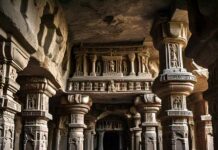
Panhala Fort, also known as Panhalgad or Panhalla, stands as a monumental testament to Maharashtra’s rich historical tapestry. Located approximately 20 kilometers northwest of Kolhapur, this fort is perched atop the Sahyadri mountain range, offering strategic oversight of the trade routes between the interior of Maharashtra and the coastal regions.
Origins and Early History
Constructed between 1178 and 1209 CE by Raja Bhoja II of the Shilahara dynasty, Panhala Fort was among the 15 forts built under his reign, including notable ones like Vishalgad and Satara . The fort’s name, translating to “the home of serpents,” is believed to derive from its serpentine layout, which also earned it the moniker “Fort of Snakes”.
Following the Shilahara dynasty, the fort came under the control of the Yadava dynasty and later the Bahamani Sultanate. In 1489, it was annexed by the Adil Shahi dynasty of Bijapur, who fortified it further, enhancing its bastions and defensive structures.
The Maratha Era and Shivaji Maharaj
Panhala Fort holds a significant place in Maratha history. Chhatrapati Shivaji Maharaj captured the fort on 28 November 1659, shortly after his victory over Afzal Khan at Pratapgad . Recognizing its strategic importance, Shivaji Maharaj used Panhala as a military base and spent over 500 days there, making it one of the few forts where he resided for an extended period.
In 1660, the fort was besieged by Siddi Jauhar of the Bijapur Sultanate. Despite a valiant defense, Shivaji was compelled to escape, leading to the legendary Battle of Pavan Khind. In this battle, Baji Prabhu Deshpande and a contingent of Maratha soldiers held off the pursuing forces, sacrificing their lives to ensure Shivaji’s safe passage to Vishalgad.
Shivaji Maharaj recaptured Panhala in 1673, stationing a significant military presence there. After his death in 1680, the fort continued to play a pivotal role in Maratha politics. It served as a residence for Queen Tarabai, who declared an independent kingdom of Kolhapur from Panhala in 1709
British Era and Modern Times
The British took control of Panhala Fort in 1827. Although its military significance waned, the fort remained a symbol of resistance. In 1844, a British colonel was held hostage by rebels within the fort, prompting a forceful response from the British . The fort remained under British control until India’s independence in 1947.
Today, Panhala Fort is a popular tourist destination, attracting history enthusiasts and trekkers alike. Its expansive fortifications, historical structures, and panoramic views of the Sahyadri range offer a glimpse into its storied past.
Architectural Highlights
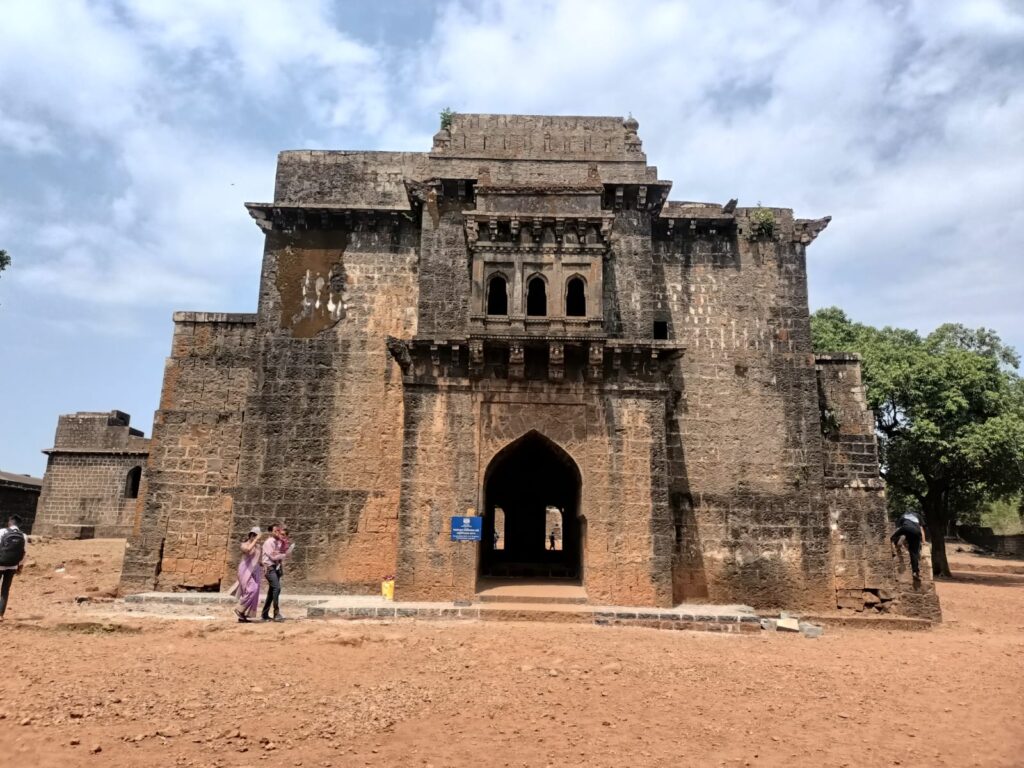
Panhala Fort spans approximately 7 kilometers in perimeter, making it one of the largest forts in the Deccan region . Notable architectural features include:
-
Triple-Walled Gates: Massive gateways designed for enhanced defense.
-
Andhar Bavadi: A concealed well ensuring water supply during sieges.
-
Ambarkhana: A granary capable of storing substantial food supplies.
-
Sajja Kothi: A structure believed to have been used for imprisoning captives.

The fort also houses temples and monuments reflecting its diverse historical influences.